
The Key to Exciting Ideas that Succeed: Understanding Your Audience
If your company is like most, you conceive of your freshest and most successful ideas over many months or even years. You may occasionally attempt to speed up the process by convening your team for brainstorming sessions that – more often than not – are fruitless.
There are reasons for this. Over a successful but lengthy development process, you gather a lot of input not only from creative minds on your team but from potential viewers and production partners or distributors. It turns out that input from your target audience and clients can be crucial to crafting fresh ideas that find success in the marketplace.
When you incorporate these opinions and reactions, you inform your creativity with real-world data. You close the feedback loop. Without feedback, the loop stays open. Your freewheeling brainstorming sessions can lead to ideas that are exciting but not at all feasible.
In media and entertainment, many of us are not used to gathering external feedback before we pitch. But for years, the most innovative product designers have been observing user behavior as part of a ‘human-centered’ or ‘design-thinking’ process. Today, event and digital content producers are embracing design thinking as well:
• In 2018, the San Francisco Museum of Art asked the firm frog for help with an augmented reality experience to accompany its exhibition of works by the Surrealist Rene Magritte.
• After alarm bells rang at the BBC about the broadcaster’s low appeal to Gen Z women, the journalists and developers at BBC News Labs embarked on a listening tour. They used what they learned to rethink the delivery of news for this crucial demographic.
The BBC team’s research was extensive and led to a new user interface as well as a different approach to content. But most studios do not need to go nearly that far.
To create a series of pitches for a particular audience segment, development teams can learn what they need to know in a few hours of research and observation. It’s key to not overdo it. You want to free the team to brainstorm and be as creative as always. But then, bring your ideas down to earth with insights into fans’ and clients’ reactions.
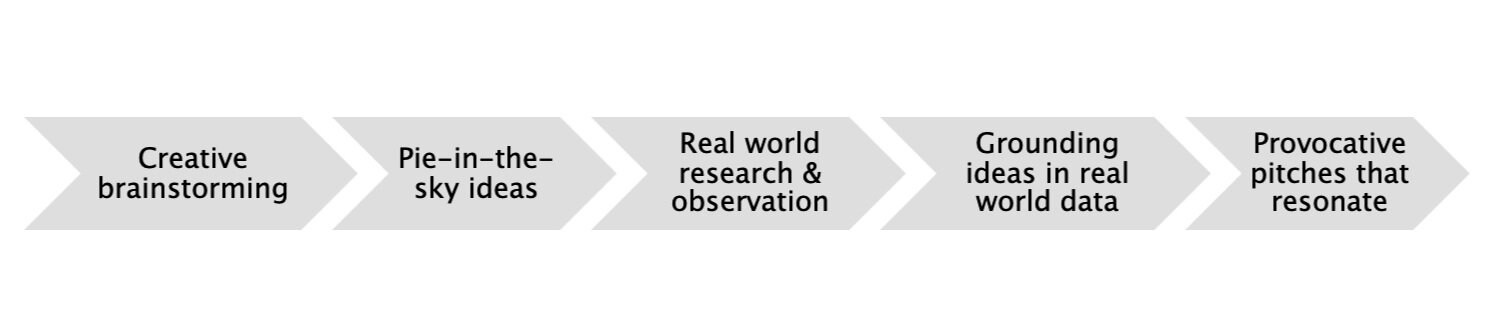
The bottom line: Close the feedback loop. Your brainstorming time won’t be wasted and you’ll have pitches that your partners are dying to hear and you’ll produce content and experiences that people really want.